
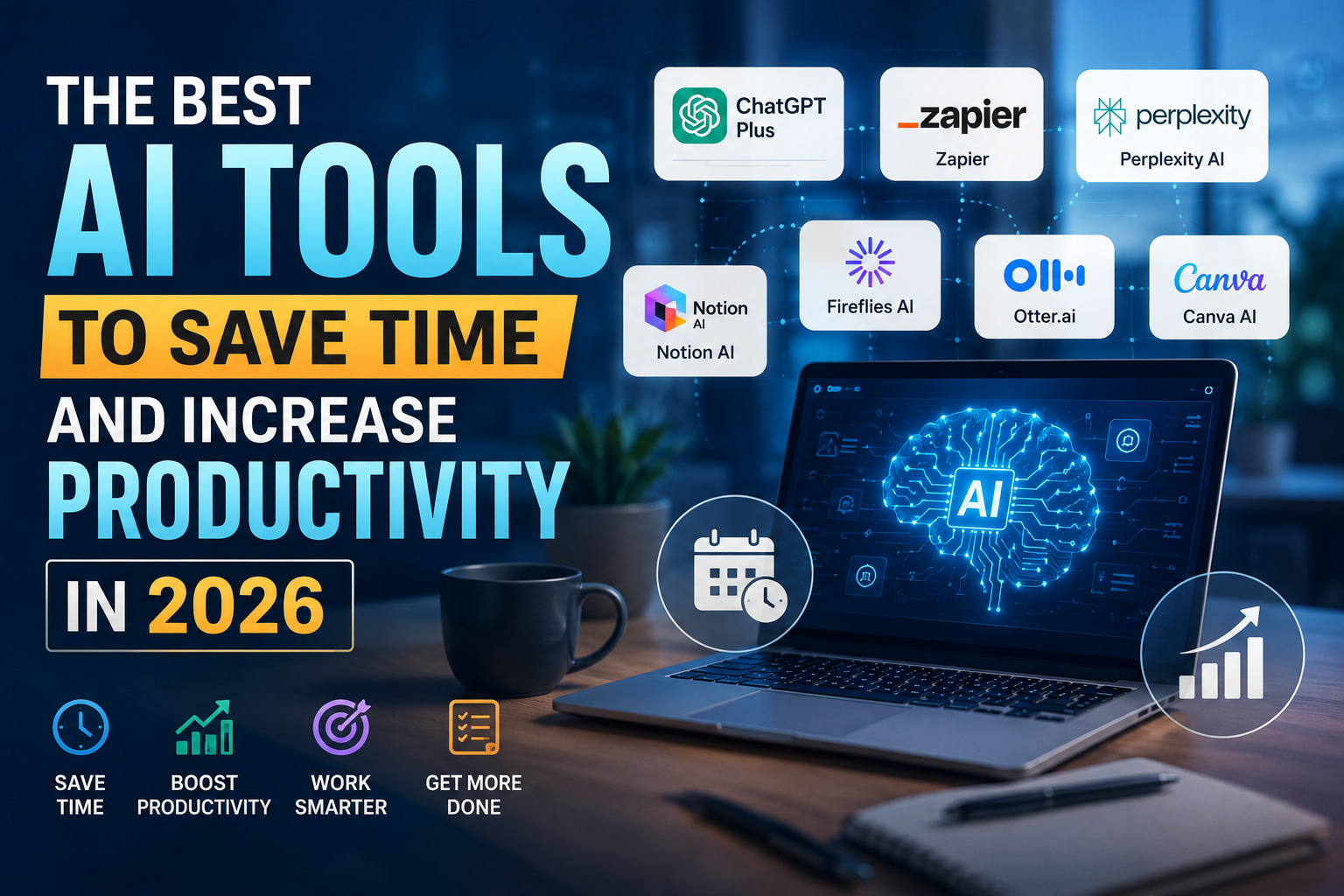
The Best AI Tools to Save Time and Increase Productivity in 2026
AI tools to save time and increase productivity are transforming the way people work in 2026. The concept of productivity has completely changed. A few years ago, increasing productivity through AI simply meant having a chat bot write a simple email or generate a short PDF moral. It was a novelty that only helped save a few minutes. Many professionals are now searching for AI tools to save time and increase productivity because these solutions help reduce repetitive work and improve efficiency.
Why AI Tools to Save Time and Increase Productivity Matter in 2026
AI does way more than that. It writes full articles, edits video, and even manages your calendar.
The digital work environment in 2026 consists of automated workflows, context-aware voice processing, and autonomous systems running in the background. Today, finding the best AI tools that save time and increase productivity is actually akin to establishing an effective digital system.
The goal of true productivity is not just to work faster but to completely eliminate daily repetitive administrative tasks, unnecessary complexity, and mental fatigue. Instead of chasing 100 tools, I picked 5 that actually run my emails, another writes my outlines, and one even schedules my posts.
Modern algorithms can now automatically organize calendars, create accurate documents by listening to unstructured audio files, and link different software programs together using plain-language instructions. For professionals, digital creators, and businesses, using these advanced systems saves hours every week. This comprehensive and human-written guide provides an overview of today’s best time-saving AI tools that are delivering greater efficiency in the professional world.
Table of Contents
1. 2026 Workflow Core Performance Criteria
2. Category 1: Advanced Research and Document Analysis
o Tool 1: Perplexity AI — Information Delivery with References
o Tool 2: Notebook LM — Your Personal and Intelligent Information Repository
3. Category 2: Intelligent Workflow Automation and Time Management
o Tool 3: n8n — Next-Generation Automated Automation System
o Tool 4: Motion — Intelligent Calendar and Deep Attention Protection System
4. Type NEXT to read the next section.
Why AI Tools to Save Time and Increase Productivity Matter in 2026
2026 Workflow Core Performance Criteria
Before evaluating different platforms, it is important to understand what features distinguish an effective productivity tool from generic and unnecessary software. High-quality AI tools must have the following four characteristics:
Verifiable Information Sources
The tool should present each answer with clear references and reliable sources, eliminating the possibility of incorrect or unverified information
Deep understanding of the work environment
The software should be able to understand and organize large amounts of information, from personal notes to thousands of pages of corporate reports.
Easy connectivity between different applications
It is important that the tool works seamlessly with your email, database, CRM, and other software, rather than confining information to a single chat window.
Minimal supervision required
The platform should truly save time, not require constant supervision, complicated instructions, or frequent changes.
Category 1: Advanced Research and Document Analysis
These tools work like a professional research team, significantly reducing the time it takes to obtain information, verify facts, and analyze large amounts of text. I tested 10 research tools last month, and most needed me to babysit them. The good ones like Perplexity just give me sources + answers in one shot.
Tool 1: Perplexity AI Providing information with references
In traditional search engines, the user has to open multiple websites, collect information from different sources, and filter out substandard content. That’s what “minimal supervision” really means in 2026. Perplexity AI simplifies the entire process and provides answers in a direct conversational style.
Simplifying the process of verifying information
Perplexity doesn’t just give guesses but instead pulls the latest information from the internet and presents it in a coherent manner with references. If you’re looking for financial data, legal changes, or information related to a particular field, you can verify the original source by looking at each reference. This reduces the chances of misinformation. That’s why references matter; they turn AI from ”just a chatbot” into a tool you can trust.
Practical example
Suppose you urgently need to know what changes have been made to international digital tax rules in 2026. In the traditional way, you would have to study several websites and government documents. But by asking Perplexity AI just one question, you can get a structured answer and relevant references in a matter of seconds. I actually tried this last week for Pakistan’s new tax update. Instead of reading 5 PDFs, Perplexity gave me the changes + direct govt. links in 30 seconds.
Tool 2: Notebook LM Your Personal and Intelligent Knowledge Base
Notebook LM, developed by Google, allows users to create a secure and private workspace based on their personal information.
Transforming unstructured information into useful knowledge
NotebookLM
uses documents you provide, such as PDFs, Google Docs, notes, and web links, as primary sources. After uploading information, you can create summaries from them, extract key points, or listen to complex topics in the form of simple audio conversations.
Key Features
- All answers are based solely on the sources you provide.
- Can process large amounts of documents with ease.
- Can convert information in different formats into a structured structure.
Category 5: Mathematical modeling, STEM skills, and code intelligence
When it comes to STEM science, technology, engineering, and math subjects, typical large language models often struggle. They operate on the basis of structural probabilities, which makes them good at generating essays and written content, but they can make minor arithmetic or logical errors in complex math, physics, or data science problems.
Complex Subjects:
1: Mathematics
2: Science
3: Physics
4: Chemistry
5: compromise
To overcome this shortcoming, modern education systems use specialized computational engines and secure runtime environments, which treat logic as a valid scientific principle rather than simply predicting text. Regular AI just guesses the next word. But these tools actually run code and check if the logic is right.
Tool 9: Wolfram Alpha + Advanced Data Analysis the engine for accurate computation
Wolfram Alpha doesn’t guess the next word but instead connects information given in natural language to its vast and well-organized computational knowledge base. When used with secure data interpreters, STEM students can visualize systems of multiple variables, solve complex calculus problems, and run simulations without error.
Natural Language Equations Symbolic Analysis Engine Wolfram Kernel
If you ask a traditional chat bot to calculate a complex tensor product or find a specific limit of an infinite series, it might give an answer that looks correct but has a significant symbolic error. The computational engine solves this problem by understanding your information mathematically, running it through a robust computational system, and presenting the answer with a step-by-step proof.
The core mathematical areas it handles are:
Calculus and differential equations:
- Computes indefinite integrals, solves boundary value problems, and explains step-by-step procedures.
- Linear algebra systems: Extracts matrix determinants, finds eigenvalues and eigenvectors, and rapidly optimizes linear transformations.
- Data-driven physical models: Simulates various structural behaviors based on real-world constants, such as gravitational drag, fluid dynamics, or wave states related to quantum mechanics.
Tool 10: GitHub Copilot and Cursor — Intelligent Coding Environment For students of Software Engineering, Computer Science, or Data Analytics,
Writing code from scratch can be daunting due to syntax errors and complex documentation. Modern AI-powered coding environments act like an assistant to programmers and help you better understand the execution flow.
Pseudo-code Context-aware code engine Basic code generation
[Quick Explanations] [Specific Bug Fixes]
Learning to Create
Instead of copying code snippets from old forums, these systems understand the structure of your local repository and suggest better classes, functions, and automated testing scripts accordingly. They also explain how a particular approach avoids memory leaks or processing bottlenecks.
Traditional Coding Workflows AI-Integrated Coding Environment
Hours spent finding a small syntax error Real-time syntax and logic checking
Reading long and complex documents Instantly generating explanatory examples
Finding nested logic problems Memory and Time Complexity Analysis
Interactive Physics and Kinematics Simulator
To understand these computational principles in practice, change various parameters to see how physical variables affect each other under the given equations. Changing these values instantly changes vector trajectories based on standard Newtonian mechanics.
A Method to Gain Deep Expertise in STEM
Instead of relying on just one tool to better understand complex technical assignments and solve problems effectively, adopt the following integrated approach.
Step 1. Identify the basic equation
Step 2: Preparation
Take your engineering or math
conclusion
Why AI Tools to Save Time and Increase Productivity Matter in 2026 Choosing the right AI tools to save time and increase productivity can help individuals and businesses work smarter in 2026. The best AI tools to save time and increase productivity are becoming essential in today’s digital workplace.