How AI is improving healthcare and medical technology
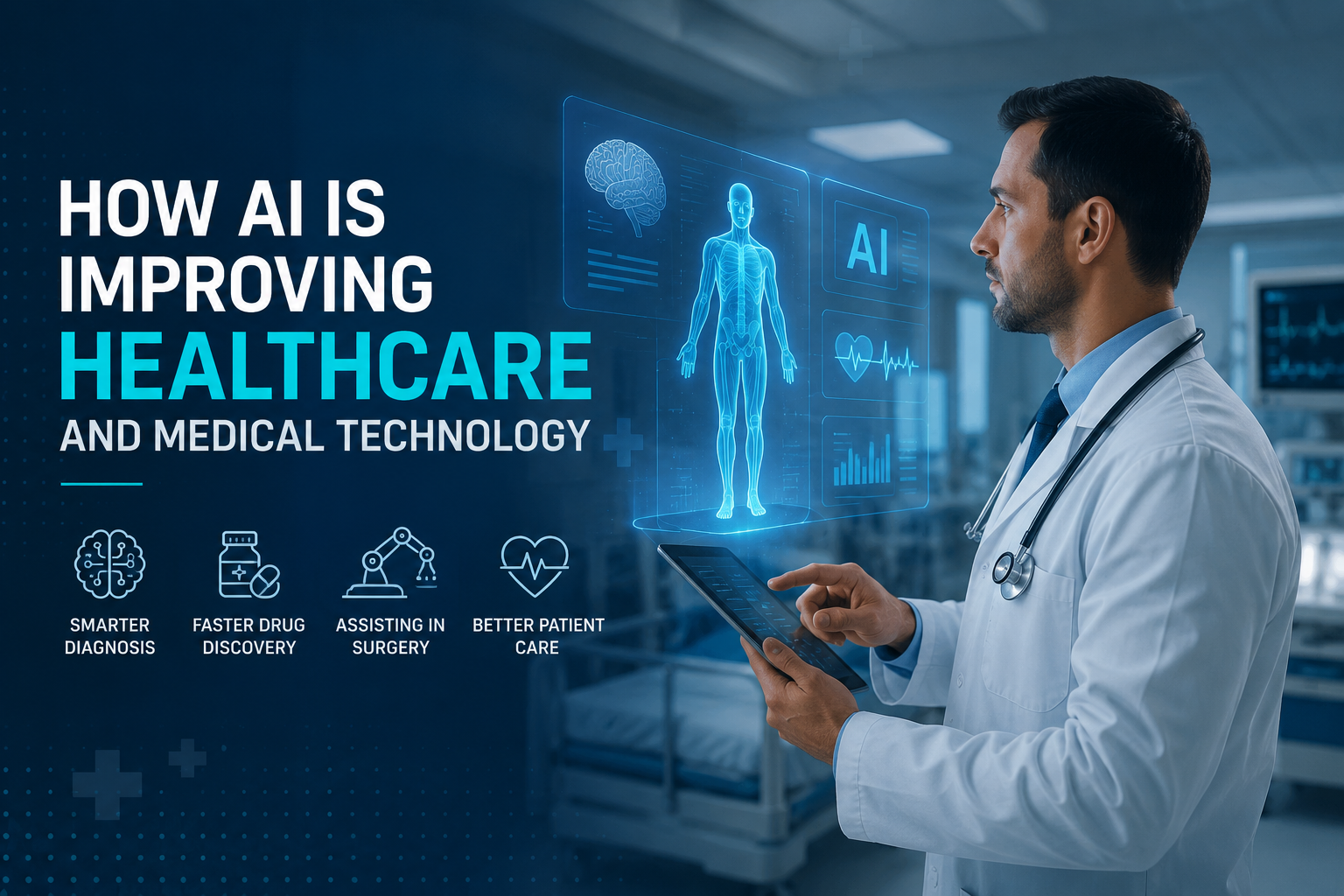
AI in healthcare is changing the healthcare industry by helping doctors, hospitals, and patients with faster and smarter medical solutions.
Today, hospitals and doctors around the world are facing many problems.
Many doctors spend a large part of their time filling out files, updating records, and writing information instead of talking to patients.
At the same time, there is a growing shortage of specialist doctors.
That is why the healthcare system is under more pressure than ever before.
But now a big change is coming.
Artificial intelligence (AI) is no longer limited to research but is now being used in the healthcare sector as well.
AI is playing an important role in identifying diseases, developing new drugs, assisting in surgery, and providing better care to patients.
AI in healthcare is becoming more popular around the world.
AI in Healthcare: Benefits for Patients
In the past, it was often the case that a person went to the doctor when he was sick.
Doctors used to identify the disease, and then treatment began.
Now AI is changing this approach.
AI can analyze large amounts of medical data and see early signs of the disease in advance.
This can help identify the risk of disease early.
AI in healthcare is becoming more popular around the world.
Collecting medical information in one place
Earlier, patient information was available in different places.
For example:
• Lab reports in one place
• X-rays in another place
• Daily health information in another place
Because of this, it was difficult to see the complete picture.
Now modern systems collect all this information in one place.
This allows doctors to understand the patient’s health better.
AI in healthcare is becoming more popular around the world.
Learning while preserving patient information
Earlier, patient information had to be collected in one place to teach AI.
This created privacy issues.
Now a new method is being used called “federated learning.”
In this, patient information is preserved in its place.
AI only learns and sends back the necessary calculations.
In this way, information is also preserved, and the system becomes even better.
AI in healthcare is becoming more popular around the world.
Early identification of diseases
The biggest advantage of AI is seen in the early identification of diseases.
Doctors have to look at hundreds of images and reports every day.
Sometimes small symptoms can be overlooked.
AI can quickly look at these images and identify suspicious areas.
AI in healthcare is becoming more popular around the world.
Helping doctors
AI does not replace doctors.
It only helps.
For example:
• Viewing X-rays
• Checking CT scans
• Reviewing eye images
This can help catch the disease early.
AI in healthcare is becoming more popular around the world.
Better diagnosis of cancer and other diseases
AI helps make the images of modern scans clearer.
This allows doctors to see the disease more easily.
This is proving to be very helpful, especially in problems like cancer.
AI in healthcare is becoming more popular around the world.
Developing new drugs faster
Creating new drugs used to be a very long and expensive process.
A drug was developed after several years of research.
Now AI is speeding up this process.
AI in healthcare is becoming more popular around the world.
Testing drugs on computers
AI can analyze millions and billions of possible chemical compounds.
It can predict which compound will work best against the disease.
This saves scientists time and programming. Help with clinical trials When a new drug is developed, it is tested on humans or others. AI can quickly find patients who are suitable for research in humans. This makes the research process easier and faster than humans.
AI in healthcare is becoming more popular around the world.
AI helps in surgery
AI and modern robotic systems are making surgery safer.
These robots do not perform surgery themselves.
They are controlled by doctors.
AI in healthcare is becoming more popular around the world.
More precise movements
Even very small movements are important during surgery.
AI helps reduce the slightest tremor of the doctor’s hands.
This makes surgery more precise.
Practice before surgery
Now doctors can create a digital model of the patient’s body.
Surgery can be practiced on this model.
This leads to better results during the actual surgery.
A unique treatment for each patient
In the past, all patients with the same disease were often given almost the same treatment.
Nowadays, AI is helping to tailor treatment to each patient’s needs and medicine.
Wearable smart devices
Today, watches and other smart devices can collect health information.
For example:
• Heart rate
• Blood oxygen levels
• Other vital body information
AI constantly monitors this information.
If a problem is detected, the doctor can be alerted when the AI is a doctor. Digital twin AI can create a digital model of the patient’s health from your input.
This allows doctors to test different treatment options first.
Then the best treatment can be selected.
Important ethical issues
Caution is very important when using AI in the healthcare sector.
Because human lives are at stake here.
Information security
It is important to keep the patient’s personal information safe.
Hospitals should use systems that protect information.
Avoid bias
If AI is trained with limited information
How does AI work in hospitals?
Now we will see how AI actually works in hospitals.
Just collecting information is not enough.
AI must also be able to understand, organize, and store the information.
The patient information journey
When a patient comes to the hospital, various types of information are collected about him.
For example:
- X-rays and MRI
- Doctor’s notes
- Heart rate information
- Blood reports
All this information comes from different places.
Modern systems collect it all in one place so that doctors can easily understand the patient’s condition.
Using different information together
All the information is viewed together to get a complete picture of the patient’s health.
AI can also see images and understand written information.
This can help to better assess the patient’s condition.
Cloud and local computers
There are some tasks that require very powerful computers.
Such tasks are done in cloud systems.
But some tasks have to be done very quickly, such as assistance during surgery.
At such times, computers inside the hospital are used so that the answer can be obtained immediately.
Helping doctors in their daily work
If software is difficult to use, doctors do not want to use it.
That is why modern AI systems work within the doctors’ existing systems.
The problem with the old system
Earlier, the doctor had to leave one system and go to another.
The information had to be rewritten.
This wasted time.
And the risk of error also increased.
AI generates notes
Now some AI systems can generate notes by listening to the patient’s and the doctor’s conversation.
The doctor only checks them later.
This saves time, and the doctor can focus more on the patient.
Real-life examples
Example 1: Helping a stroke patient
Every minute is crucial in a stroke.
If treatment is delayed, brain damage can occur.
AI can immediately check the scan and alert a specialist doctor.
This allows treatment to begin sooner.
Example 2: Early detection of infection
Sometimes the symptoms of a dangerous infection are very subtle at first.
AI is constantly looking at information.
If signs of danger are seen, the doctor can be informed quickly.
This can help save the patient’s life.
Example 3: Identifying heart disease
Some heart diseases are not easily visible at first.
AI can see small changes in heart tests.
This can help catch the disease early and start treatment on time.
Different medical AI tools
Not every AI tool works the same.
Some tools review images.
Some help doctors create notes.
Some analyze patient information.
Summary
AI helps hospitals understand and organize information quickly.
It is proving to be helpful in early identification of diseases, making doctors’ work easier, and providing better care to patients.
But the final decision is always made by the doctor.
That is why AI and doctors together achieve the best results.
Foundation of AI in health sector in hospitals
To understand how AI is changing the healthcare sector in everyday life.
It is not about replacing doctors with AI.
Rather, it’s about helping doctors make better, faster decisions; it is not.
How does AI work?
Older computer systems worked on predetermined rules.
For example:
If the blood pressure goes above a certain limit, the system will alert.
But this method could not understand every disease correctly.
Modern AI systems now learn from information themselves.
It looks for patterns in patient information that are hidden from plain view.
Understanding medical images
AI can view images such as X-rays, CT scans, and MRIs.
It examines different parts of the image.
Identifies the first edge.
Then she understands the different parts of the body.
And finally can find even the smallest sign of disease.
For example:
• Minor lung problem
• Fine fissures in the bone
• Abnormal body changes
Understanding doctors’ notes
AI doesn’t just look at pictures.
It can also read notes written by doctors.
If there are different symptoms recorded in the patient file, the AI can find the correlation between them.
This can give the doctor an early diagnosis of a possible disease.
Connecting different systems of hospitals
Earlier patient information was stored in different computers.
For this reason it was difficult to see complete information at once.
Modern medical systems can now integrate disparate information into one place.
This makes it easier for the doctors to understand the complete situation of the patient.
A global standard for medical imaging
Hospitals around the world use a special system to store medical images in a uniform manner.
This allows different hospitals and computers to easily read the same image.
Fast exchange of information
Modern medical systems can instantly send new patient information from one place to another.
For example:
• Blood report
• Heart palpitations
• New drug information
All these things are updated quickly.
Real-world uses of AI
1. Support for stroke patients
Every minute is precious in a stroke.
AI can instantly identify danger by looking at brain scans.
This allows doctors to start treatment sooner.
2. Early detection of cancer
Doctors look at tissue samples to identify cancer.
AI can highlight suspicious parts in these samples.
This can catch the disease early.
3. Priority of emergency patients
Sometimes the hospital has too many scans.
AI can identify dangerous cases earlier.
Patients with higher needs receive treatment sooner.
Difference between old and new system
Old System Modern AI System
Acts on pre-established rules and learns from information
Sees separate information Sees all information together
Less human labor required makes work faster and easier
The disease may take longer to catch but early detection helps
Summary
AI is helping doctors in the healthcare sector.
It plays an important role in reviewing medical images, understanding patient information, and early detection of diseases.
But AI doesn’t make decisions by itself; it making decision to human input or itis better ideas then humans
The final decision is always made by the doctor, not computers.
That’s why AI and doctors work together to deliver better treatments to their patients.
I have changed this part into simple language with children according to your rule.