
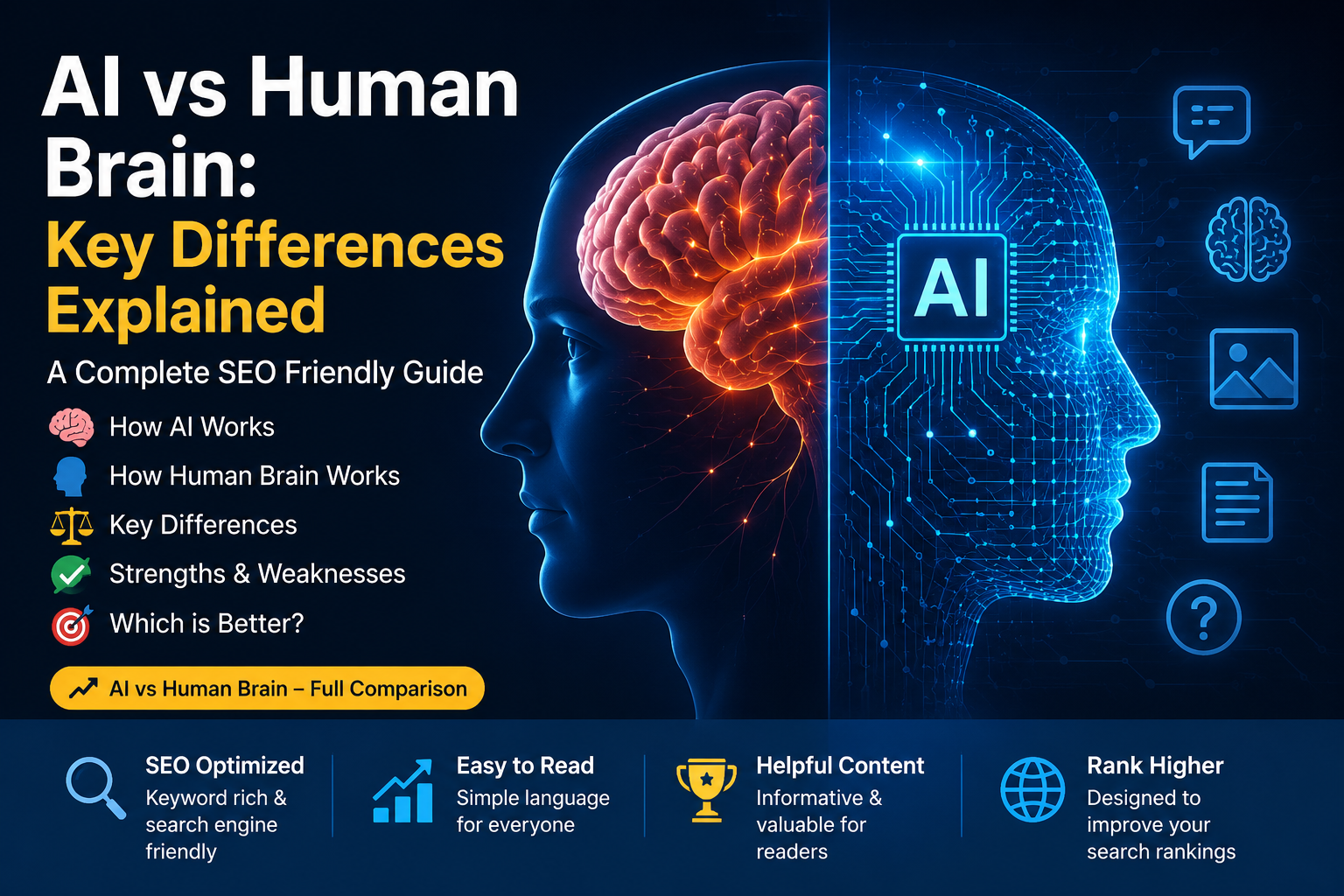
Nowadays, people talk a lot about the difference between AI and the human brain
AI vs. human intelligence is one of the most discussed topics in modern technology. Many people want to understand how artificial intelligence differs from human intelligence. This guide explains AI vs. human intelligence in simple and easy words. We hear every day that AI is writing stories, drawing pictures, passing exams, and answering difficult questions.
Therefore, a question comes to many people’s minds:
Does AI think like humans?
The answer to this question is not so simple.
The fact is that AI and the human brain are not the same. The way they work is different. Both use different methods to solve problems. Both have different strengths and weaknesses.
Understanding this difference is very important in today’s era. Especially for those who use new technology, work online, or seek help from AI tools.
AI vs Human Intelligence: Main Differences
1. Basic structure of AI and the human brain
o How does a computer work?
o How does the human brain work?
2. How does learning work?
o Why do machines need more examples?
o How do humans learn from fewer examples?
3. Problem-solving style in calligraphy
o How does AI understand language in computer languages like C++, Python, Java, and other computer languages?
o How do humans understand emotions and situations in our power of AI?
4. Special abilities of both
o What are AIs good at?
o What are humans better at?
Basic structure of AI and human brain
If we want to know the difference between AI and humans, we first have to understand how both are made.
How does a computer work?
Every AI system works with the help of computer chips, electricity, and code.
When you ask an AI a question, it does not think like a human.
It only calculates numbers.
AI converts your words into numbers and then guesses what the next word should be in binary digits and digital signals.
Similarly, it connects each word to form a complete answer to your question in different kinds of questions.
It does not have its own thoughts, feelings, or memories; in every way, it feelings must be had in humans.
It only guesses and answers very quickly to your questions.
How does the human brain work?
The human brain is completely different from AI.
Our brain is made up of billions of cells that are constantly communicating with each other, but AI does not have a brain; it has a CPU in its system. It is its brain.
We don’t just see information; we also feel it and provide ideas for your computer.
When we learn something new like that, we associate it with our old memories, experiences, emotions, and life situations in everyday life.
That’s why humans don’t just understand words; they also understand their meaning or information.
For example,
When we listen to a song or read a story in our book, we also feel its emotions and feelings.
AI can’t do this.
Differences between AI and human performance
Now we will understand how AI and humans perform difficult tasks in everyday life.
The difference between AI and humans is clearly visible in everyday tasks.
Robotics is performing tasks that were done traditionally by human beings. Tasks include diffusing landmines, booms, firefighting, lifting heavy objects, manufacturing, and others.
This shows how both use energy, how they handle sudden changes in situations, and how they understand communication.
AI is not magic. It is a fast calculation tool. If we use the speed of AI and the understanding of humans together, the work can be improved.
Energy difference
A big difference between AI and the human brain is the energy level
To run AI, large computers, servers, and a lot of electricity are required.
But the human brain works with very little energy.
AI needs a lot of electricity in everyday life
To run large AI, companies have to build large data centers and small ones.
They have thousands of computers on servers. These computers use a lot of electricity in everyday life.
They get so hot that they also need special systems to keep them cool.
Even to answer a simple question, AI has to take the help of powerful computers.
The human brain works with low energy
The human brain is very amazing.
It does great things with very little energy.
Humans think, write, drive, hear sounds, see things, and also understand feelings.
At the same time, our brain is also running many body functions, such as heartbeat, breathing, seeing with our eyes, and protecting the body.
The brain does all this work with very little energy.
Understanding changing situations
AI is good at tasks where the rules are clear and the same thing has to be done again and again.
But the world is not always the same. Sometimes situations change suddenly.
AI can get into trouble in new situations
For example,
AI can be very good at chess, because the rules of chess are predetermined.
But if a new problem suddenly arises, for which there is no previous example, then AI can also give the wrong answer.
AI guesses based on old information. If the problem is completely new, it becomes difficult for it to understand.
Humans can think better in new situations
Humans have experience, thinking, and understanding.
When a new problem arises, humans take help from their old experiences.
They can use what they have learned from one task in another.
That is why humans can come up with new solutions in difficult times.
Human power to understand communication in their languages like C++, Python, Java, and C
Communication is not just about words.
It also includes feelings, tone, jokes, anger, sadness, situations, and human emotions or feelings.
AI matches words with guesses
AI chooses words that have been used a lot before to understand their words.
That is why sometimes the words written by AI are clear in words, but they seem a little cold and mechanical or mechanistic.
It lacks human-like feeling or emotions.
Humans also understand hidden things
Humans don’t just listen to words but also understand the tone and mood of every human.
For example, if a person says the following:
“Wow, work is late again, great!”
Then AI might see the word “good” and think it’s a matter of happiness.
But humans immediately understand that this is sarcasm and the person in front of them is angry about her answer.
Humans can understand other people’s feelings better than AI.
Using AI and humans together in everyday life
It’s not right to consider AI as a replacement for humans.
A better way is to use AI as a helpful tool.
AI can work faster, and humans can check and improve this work.
Let AI do difficult and repetitive tasks
Give AI tasks that have to be done repeatedly.
For example:
Organizing data, cleaning up long files, doing calculations, or grouping words is in every student’s life.
This saves time and gets the job done quickly or faster.
Humans must do the final check
AI work should always be checked by humans.
Rewrite what the AI has written in your own language.
Extract machine sentences.
Simplify long sentences in the dictionary.
Check every date, number, and piece of information yourself to simplify difficult words using AI to human beings.
Similarly, AI’s speed and human understanding can work well together.
AI and Humans Working Together
Now we will see how AI and humans work in real life.
This will help us understand where AI can help and where humans are needed.
AI and Humans in Everyday Work
Example 1
Customer Support
Suppose parcels are arriving late in an online shop due to bad weather.
What will the AI do?
The AI will read people’s messages and give the same response.
Example:
“We apologize for the delay. Your parcel is on its way.”
AI vs Human Intelligence in Daily Life
This response can be sent repeatedly.
What will the human do?
The human can understand that people are worried.
He can explain the exact situation, reassure people, and send the necessary parcels first.
This way, people’s trust is maintained.
AI vs Human Intelligence in Daily Life
Example 2
Calculation and Data Checking
Suppose there are thousands of records in a file.
AI vs Human Intelligence in Daily Life
What will the AI do?
The AI will calculate very quickly.
Can find wrong records.
Can organize the file.
And can also make graphs.
What will a human do?
A human can understand the reason behind the numbers.
For example, if there is less income in a month, a human can find the reason.
He can understand what the real problem was and what to do next.
Example 3
Writing an article
Suppose a blogger is creating a new website.
What will an AI do?
AI can provide titles, outlines, and basic information.
But often such an article looks like other articles.
What will a human do?
A human will add his own story, experience, and examples.
This makes the article more interesting and unique.
People also like it more.
AI vs Human Intelligence in Daily Life
Common questions
Can AI think like a human?
No.
AI answers by calculation and guesswork.
It does not have feelings, consciousness, or human thinking.
AI vs Human Intelligence in Daily Life
Why does an AI sometimes give wrong information?
Sometimes AI makes guesses.
Therefore, sometimes the information it provides may be incorrect.
How do search engines recognize low-quality articles or SEO friendliness?
If an article contains the same sentences over and over again and looks machine-like, search engines may consider it to be lower quality than higher quality.
That is why it is important to write in a human-like manner.
AI vs Human Intelligence in Daily Life
What is the safe use of AI in online work?
Do not let AI do difficult and time-consuming tasks.
After that, the human should check the information himself and create content in his own language.
AI vs Human Intelligence in Daily Life
Will AI replace all writers in the future?
No.
AI can write faster than humans, but it cannot replace human experience, emotions, and creative thinking or overthinking.
A simple comparison between AI and humans: it works together
AI vs Human Intelligence in Daily Life
AI vs Human
It runs on computers; like a CPU is his brain, works on the brain’s hundreds of cells
Faster in calculations, better in understanding
Requires a lot of data in RAM ROM, learns from fewer examples in their mind
Does not understand emotions or feelings; understands emotions and creative thinking
Works quickly as input, has creative thinking
They can make wrong guesses in their questions and can decide according to the situation of humans.
final Summary
Both AI and humans are good at performing different tasks.
AI helps in quick calculations, organizing information, and performing repetitive tasks faster.
Humans are better at thinking, understanding, making decisions, and feeling emotions.
The best way is to use both AI and humans together.
AI does difficult and time-consuming tasks, while humans check the information and use their understanding.
In this way, the best results can be achieved for our goals.
Finally, remember that AI did not come to replace humans, but to help humans. Let it be your teacher
When the speed of AI and human understanding work together, better results are achieved in make to your goals